Salary to Hourly: How to Convert Your Salary to an Hourly Rate (with Examples)
Published November 5, 2026 · 7 min read
A job ad says $55,000 a year. Another says $27 an hour. Which one pays more? To compare them you need both numbers in the same unit, and that's a two-minute calculation once you know the formula. This guide shows the formula, a calculator that does it for you, a quick reference table and worked examples for yearly, monthly and part-time pay.
Quick answer: hourly rate = yearly salary ÷ (hours per week × weeks per year).
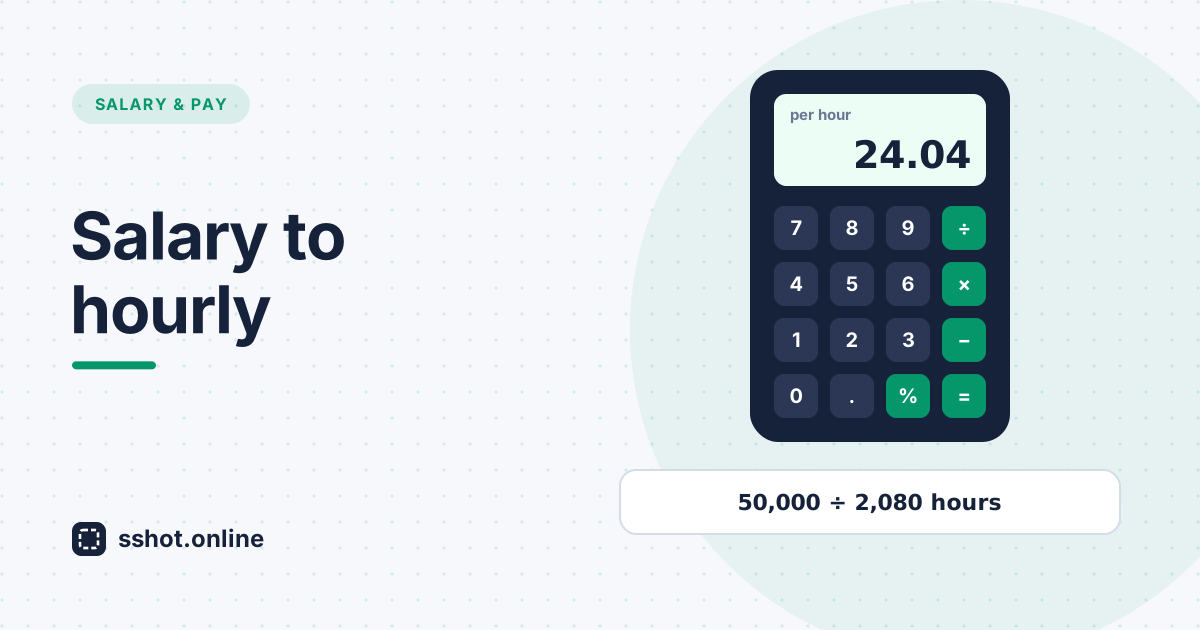
For a standard 40-hour week, divide the yearly salary by 2,080. So $50,000 a year is $50,000 ÷ 2,080 = $24.04 an hour.
Salary to hourly calculator
Works with any currency. Results are before tax.
The salary to hourly formula
Your hourly rate is simply your pay divided by the hours it pays for. For a yearly salary:
hourly rate = yearly salary ÷ (hours per week × weeks per year)Most full-time jobs are 40 hours a week, and a year has 52 weeks. 40 × 52 = 2,080 working hours a year, which is why 2,080 is the number you'll see everywhere.
Example: $50,000 a year
- Work out the hours in a year: 40 hours × 52 weeks = 2,080 hours.
- Divide the salary by the hours: $50,000 ÷ 2,080 = $24.038...
- Round to cents: $24.04 an hour.
Yearly salary to hourly: quick reference table
Based on 40 hours a week and 52 paid weeks a year.
| Yearly salary | Monthly | Weekly | Hourly |
|---|---|---|---|
| $30,000 | $2,500.00 | $576.92 | $14.42 |
| $40,000 | $3,333.33 | $769.23 | $19.23 |
| $50,000 | $4,166.67 | $961.54 | $24.04 |
| $60,000 | $5,000.00 | $1,153.85 | $28.85 |
| $70,000 | $5,833.33 | $1,346.15 | $33.65 |
| $80,000 | $6,666.67 | $1,538.46 | $38.46 |
| $100,000 | $8,333.33 | $1,923.08 | $48.08 |
| $120,000 | $10,000.00 | $2,307.69 | $57.69 |
Monthly salary to hourly
Turn the monthly salary into a yearly one first, then divide by the yearly hours:
hourly rate = monthly salary × 12 ÷ 2,080Example: $4,000 a month × 12 = $48,000 a year. $48,000 ÷ 2,080 = $23.08 an hour.
A common mistake is to divide the monthly salary by 160 hours (4 weeks × 40 hours). That gives $25.00, which is too high. A month isn't 4 weeks: it's 52 ÷ 12 = about 4.33 weeks, or about 173 working hours. If you want a single number for monthly pay, divide by 173.33.
Hourly rate to yearly salary
Go the other way by multiplying:
yearly salary = hourly rate × hours per week × weeks per year| Hourly rate | Weekly (40 h) | Yearly (2,080 h) |
|---|---|---|
| $15 | $600 | $31,200 |
| $20 | $800 | $41,600 |
| $25 | $1,000 | $52,000 |
| $30 | $1,200 | $62,400 |
| $40 | $1,600 | $83,200 |
So back to the opening question: $27 an hour × 2,080 = $56,160 a year, which beats the $55,000 salary, as long as both jobs need the same hours.
The mental-maths shortcut
2,080 is close to 2,000, so for a quick estimate you can halve the salary in thousands:
- $50,000 a year → about $25 an hour (exact: $24.04)
- $80,000 a year → about $40 an hour (exact: $38.46)
And the reverse: double the hourly rate to get thousands per year. $20 an hour is about $40,000 a year (exact: $41,600). The shortcut always slightly overstates the hourly rate, so use the calculator when the exact number matters.
Different working hours
Not everyone works 40 hours. Change the hours and the result changes a lot:
| Hours per week | Hours per year | $50,000 a year is |
|---|---|---|
| 35 | 1,820 | $27.47 an hour |
| 37.5 | 1,950 | $25.64 an hour |
| 40 | 2,080 | $24.04 an hour |
| 45 | 2,340 | $21.37 an hour |
| 50 | 2,600 | $19.23 an hour |
That last row matters when you compare offers. A $50,000 job with 50-hour weeks pays less per hour than a $42,000 job with 40-hour weeks ($20.19 an hour).
What about holidays and time off?
- Paid holidays and vacation: keep 52 weeks. You're paid for those weeks, so they count.
- Unpaid time off: use fewer weeks. With 2 unpaid weeks, use 50: $50,000 ÷ (40 × 50) = $25.00 an hour.
- Want the rate for hours you actually work? Some people subtract paid vacation too, to see what they earn per hour at their desk. That's a fair way to compare jobs with very different amounts of leave.
Before tax, not take-home pay
Every number on this page is gross pay: what you earn before income tax, social security and other deductions. Your take-home hourly rate will be lower, and how much lower depends on where you live. When comparing job offers, compare gross to gross.
Freelancers: why your hourly rate should be higher
If you're leaving a salaried job to freelance, don't just charge your old hourly rate. An employee's salary comes with paid leave, equipment and often benefits, and employees don't spend unpaid hours finding clients or sending invoices. Freelancers pay for all of that themselves, which is why many set their rate well above their old salaried hourly rate.
Related calculations
- Got a raise? Work out the salary increase percentage.
- Worked extra hours? See how to calculate overtime pay.
- Part-time or starting mid-month? Use the pro-rata salary calculator.
Frequently asked questions
How do I convert my salary to an hourly rate?
Divide your yearly salary by the number of hours you work in a year. For a 40-hour week over 52 weeks that's 2,080 hours, so $50,000 a year is $50,000 ÷ 2,080 = $24.04 an hour.
How many working hours are in a year?
A full-time job of 40 hours a week for 52 weeks has 2,080 working hours a year. A 37.5-hour week has 1,950 hours and a 35-hour week has 1,820 hours.
How much is $60,000 a year per hour?
At 40 hours a week, $60,000 a year is $28.85 an hour, $1,153.85 a week and $5,000 a month, before tax.
How do I convert a monthly salary to hourly?
Multiply the monthly salary by 12 to get the yearly salary, then divide by 2,080. A $4,000 monthly salary is $48,000 a year, which is $23.08 an hour. Dividing by 160 overstates the rate because a month is about 4.33 weeks, not 4.
Is the hourly rate before or after tax?
The formula gives your gross hourly rate, before tax and other deductions. Your take-home pay per hour will be lower.
Related articles
How to Calculate a Salary Increase Percentage (with Examples)
Work out your raise as a percentage or your new salary after a raise, and check whether it beats inflation. Free calculator and examples.
Read More →
How to Calculate Overtime Pay: Time and a Half and Double Time Examples
The time-and-a-half formula, double time, daily overtime and overtime on a salary, with a free calculator to check your payslip.
Read More →
How to Calculate Pro-Rata Salary for Part-Time Work or a Partial Month
Pro-rata pay for part-time hours, FTE and leave, plus pay for a month when you start or leave mid-month. Free calculator and examples.
Read More →