How to Calculate Overtime Pay: Time and a Half and Double Time Examples
Published November 5, 2026 · 8 min read
You worked 46 hours this week instead of 40. How much extra should your paycheck show? Overtime is easy to get wrong because only some of your hours are paid at the higher rate, and the rules depend on your contract and where you work. This guide gives you the formula, a calculator and worked examples you can check your payslip against.
Overtime rate = hourly rate × 1.5 ("time and a half").
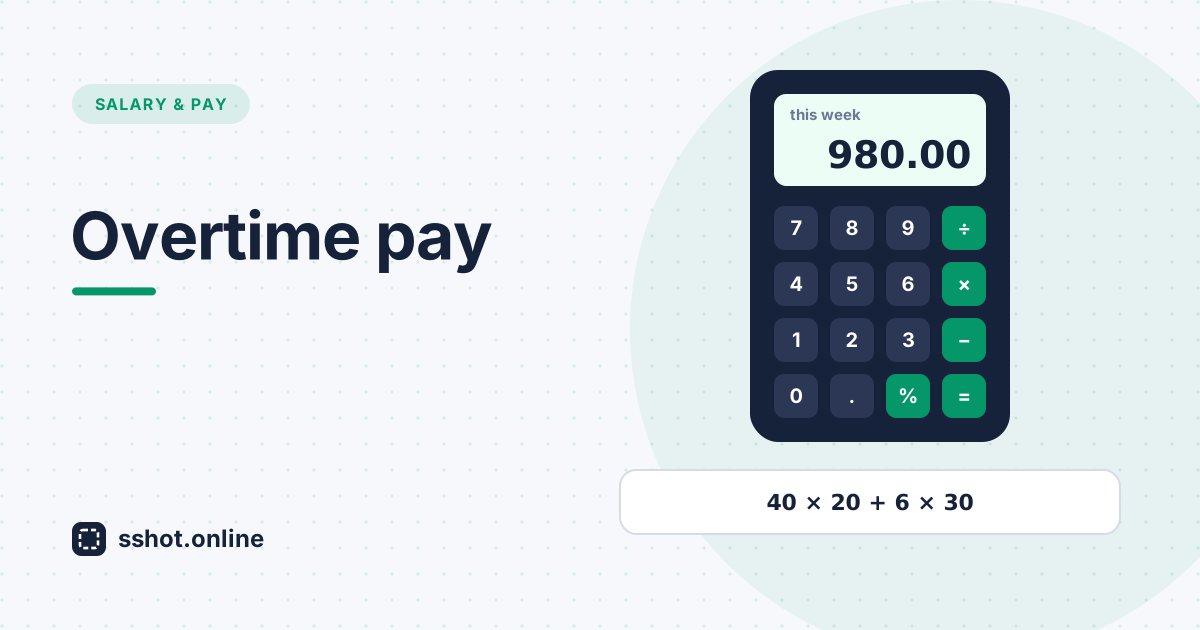
Weekly pay = regular hours × hourly rate + overtime hours × overtime rate. At $20 an hour for 46 hours: 40 × $20 + 6 × $30 = $980.
Overtime pay calculator
Double-time hours are counted separately from the hours above, for example a public holiday paid at double time. Results are before tax.
The overtime formula, step by step
Overtime is usually paid only for the hours above a limit, most often 40 hours a week. The hours up to the limit are paid at your normal rate.
- Split your hours. 46 hours worked − 40 regular = 6 overtime hours.
- Find the overtime rate. $20 × 1.5 = $30 an hour.
- Pay the regular hours. 40 × $20 = $800.
- Pay the overtime hours. 6 × $30 = $180.
- Add them up. $800 + $180 = $980.
A quick check: 46 hours at the normal rate would be $920. Overtime adds an extra half-rate on 6 hours, 6 × $10 = $60, and $920 + $60 = $980.
Time and a half and double time rates
| Hourly rate | Time and a half (1.5×) | Double time (2×) |
|---|---|---|
| $15.00 | $22.50 | $30.00 |
| $18.00 | $27.00 | $36.00 |
| $20.00 | $30.00 | $40.00 |
| $25.00 | $37.50 | $50.00 |
| $30.00 | $45.00 | $60.00 |
Example 2: time and a half plus double time
Sam earns $18 an hour. This week Sam worked 44 regular-day hours plus 3 hours on a public holiday that the contract pays at double time.
- Regular: 40 × $18 = $720
- Overtime: 4 × $27 = $108
- Double time: 3 × $36 = $108
- Total: $936
Example 3: overtime on a salary
Some salaried employees are entitled to overtime too. The first step is to turn the salary into an hourly rate. For a fixed salary that covers a 40-hour week:
- Weekly pay: $52,000 ÷ 52 = $1,000.
- Hourly rate: $1,000 ÷ 40 = $25.
- Overtime rate: $25 × 1.5 = $37.50.
- 5 overtime hours: 5 × $37.50 = $187.50.
- Week's pay: $1,000 + $187.50 = $1,187.50.
Set "My pay is" to Yearly salary in the calculator to do this automatically. Need the hourly rate on its own? See our salary to hourly guide.
Example 4: daily overtime
Some places count overtime per day, not per week. In California, for example, non-exempt employees get 1.5× for hours over 8 in a workday and 2× for hours over 12. A 10-hour day at $20 an hour is:
- 8 × $20 = $160
- 2 × $30 = $60
- Total for the day: $220
To use the calculator for one day, set "Overtime starts after" to 8 and enter that day's hours.
Who gets overtime?
Overtime rules come from employment law and your contract, so they differ by country, state and job:
- United States: under the Fair Labor Standards Act (FLSA), non-exempt employees must get at least 1.5× their regular rate for hours over 40 in a workweek. Exempt employees, usually salaried managers and professionals above a pay threshold, aren't covered. Some states add their own rules, like California's daily overtime.
- Other countries: some set a legal overtime premium, others leave it to employment contracts and collective agreements. Your contract or staff handbook should say which hours count as overtime and at what rate.
If your payslip looks wrong, check your contract first, then ask payroll to show you the calculation.
Common overtime mistakes
- Paying all hours at 1.5×. Only the hours above the limit get the higher rate: 46 hours isn't 46 × $30.
- Averaging two weeks. Under the FLSA each workweek stands alone. Working 50 hours one week and 30 the next still means 10 overtime hours in the first week.
- Using the wrong regular rate. In the US, some bonuses and commissions must be included in the regular rate before multiplying by 1.5, which raises the overtime rate.
- Forgetting paid breaks or rounding. Keep your own record of start and finish times so you can check the hours.
Related calculations
- Convert a salary to an hourly rate
- Work out a raise as a percentage
- Calculate pro-rata pay for part-time work
Frequently asked questions
How do I calculate time and a half?
Multiply your hourly rate by 1.5. At $20 an hour, time and a half is $30 an hour. Then multiply that rate by the number of overtime hours.
How much is 6 hours of overtime at $20 an hour?
At time and a half, the overtime rate is $30, so 6 overtime hours pay $180. With 40 regular hours ($800) the week totals $980 before tax.
Is overtime paid on all hours worked?
No. Overtime is normally paid only on hours above a limit, usually 40 hours a week. Hours up to the limit are paid at the regular rate.
How do I calculate overtime on a salary?
Turn the salary into an hourly rate first. For a $52,000 salary covering 40-hour weeks, weekly pay is $1,000 and the hourly rate is $25, so the overtime rate is $37.50.
What is double time?
Double time pays twice the regular hourly rate. Some contracts use it for public holidays or very long days; in California it applies to hours over 12 in a workday.
Related articles
Salary to Hourly: How to Convert Your Salary to an Hourly Rate (with Examples)
Turn a yearly or monthly salary into an hourly rate with one simple formula. Free calculator, quick reference table and worked examples.
Read More →
How to Calculate a Salary Increase Percentage (with Examples)
Work out your raise as a percentage or your new salary after a raise, and check whether it beats inflation. Free calculator and examples.
Read More →
How to Calculate Pro-Rata Salary for Part-Time Work or a Partial Month
Pro-rata pay for part-time hours, FTE and leave, plus pay for a month when you start or leave mid-month. Free calculator and examples.
Read More →