How to Calculate Pro-Rata Salary for Part-Time Work or a Partial Month
Published November 5, 2026 · 8 min read
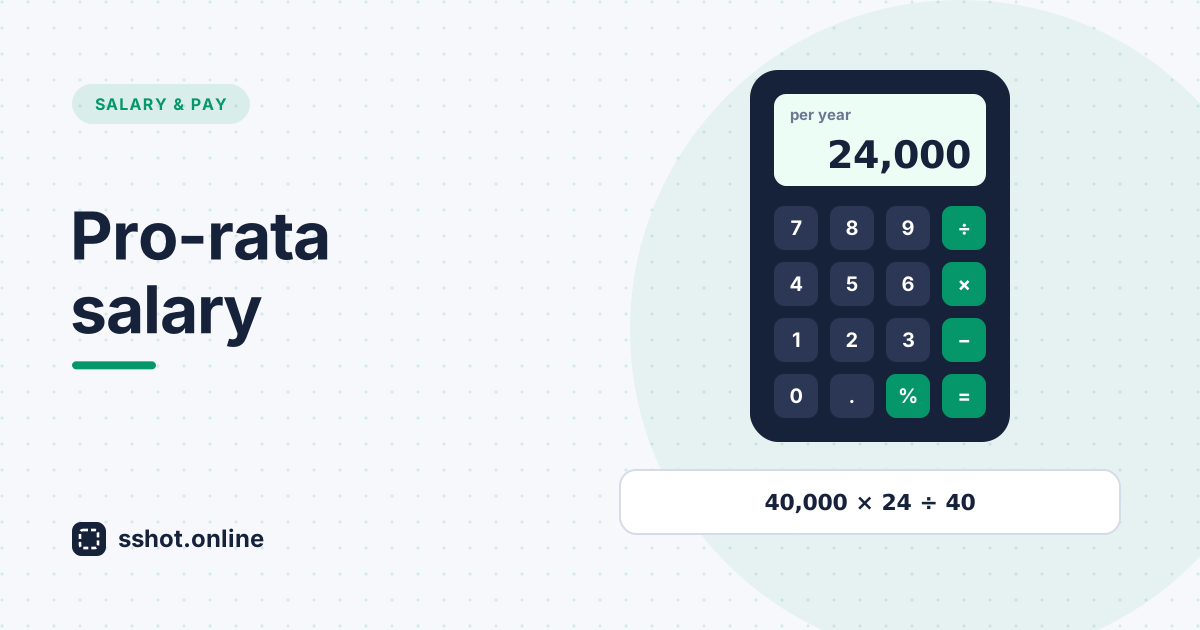
"Pro rata" is Latin for "in proportion". A pro-rata salary is the full-time salary scaled down to the part you actually work. It comes up in two everyday situations: a part-time job advertised as "$40,000 pro rata", and your first or last month in a job, when you only work part of the month. This guide covers both, with a calculator and worked examples.
Part-time: pro-rata salary = full-time salary × your hours ÷ full-time hours. $40,000 at 24 of 40 hours = $24,000.
Partial month: pay = monthly salary × days worked ÷ days in the month. $3,000 for 21 of June's 30 days = $2,100.
Pro-rata salary calculator
Both dates must be in the same month. Public holidays are not taken out of the working days. Check your contract to see which method your employer uses.
Part 1: Pro-rata salary for part-time work
When a job is advertised as "$40,000 pro rata", $40,000 is what you'd earn working full time. You earn the share of it that matches your hours:
pro-rata salary = full-time salary × (your hours ÷ full-time hours)Example: 24 hours a week
- Work out your share: 24 ÷ 40 = 0.6. This number is your FTE (full-time equivalent). 1.0 is full time and 0.6 is 60% of full time.
- Multiply the full-time salary: $40,000 × 0.6 = $24,000 a year.
- Monthly pay: $24,000 ÷ 12 = $2,000.
More part-time examples
| Full-time salary | Full-time week | Your week | FTE | Pro-rata salary |
|---|---|---|---|---|
| $40,000 | 40 hours | 24 hours | 0.6 | $24,000 |
| $45,000 | 37.5 hours | 30 hours | 0.8 | $36,000 |
| $50,000 | 5 days | 3 days | 0.6 | $30,000 |
| $36,000 | 40 hours | 20 hours | 0.5 | $18,000 |
| $60,000 | 35 hours | 28 hours | 0.8 | $48,000 |
You can use days instead of hours, as in the third row, as long as every day is the same length. Your hourly rate stays the same as a full-timer's. You just work fewer hours.
Pro-rata holiday
Paid leave is usually scaled the same way. If full-timers get 25 days and your FTE is 0.6, you get 25 × 0.6 = 15 days. Add the full-time leave days in the calculator to see your share. Some countries have their own rules for part-time leave, so check your contract or local guidance.
Part 2: Pay for a partial month
Started on the 10th? Leaving on the 13th? Your first or last payslip covers only part of the month. Employers use one of two methods, and they give different answers.
Method 1: calendar days
pay = monthly salary × days worked ÷ days in the monthEvery day counts, including weekends. Starting on 10 June 2026 with a $3,000 monthly salary, you're employed from the 10th to the 30th, which is 21 days. June has 30 days:
$3,000 × 21 ÷ 30 = $2,100.
Method 2: working days
pay = monthly salary × working days worked ÷ working days in the monthOnly Monday to Friday count. June 2026 has 22 working days, and from the 10th to the 30th there are 15 of them:
$3,000 × 15 ÷ 22 = $2,045.45.
Same person, same month, a $54.55 difference. Neither method is wrong. Your employment contract or your payroll team decides which one applies, so the calculator shows both.
Example: leaving mid-month
Your last day is 13 March 2026 and you earn $3,100 a month. March has 31 days, and you worked 13 of them. With the calendar-day method: $3,100 × 13 ÷ 31 = $1,300.
Method 3: a daily rate from the yearly salary
Some employers start from the yearly salary instead, which gives the same daily rate in every month:
- Calendar days: yearly salary ÷ 365. $36,000 ÷ 365 = $98.63 a day, so 21 days = $2,071.23.
- Working days: yearly salary ÷ 260 (52 weeks × 5 days). $36,000 ÷ 260 = $138.46 a working day.
Pro-rata bonuses
Bonuses are often pro-rated for people who joined part-way through the year. If the full bonus is $5,000 for a January to December year and you joined on 1 April, you were there for 9 of 12 months: $5,000 × 9 ÷ 12 = $3,750.
Quick checklist before you accept a pro-rata offer
- Ask for the full-time salary and the full-time hours. Both are needed to check the maths.
- Ask how leave and public holidays are pro-rated.
- Check whether your hours could change, and how that affects the FTE.
- Compare offers per hour with our salary to hourly calculator.
Frequently asked questions
What does pro rata salary mean?
Pro rata means "in proportion". A pro-rata salary is the full-time salary scaled to the hours or days you actually work. A $40,000 pro-rata job at 24 of 40 hours pays $24,000 a year.
How do I calculate pro-rata salary for part-time hours?
Divide your weekly hours by the full-time weekly hours to get your FTE, then multiply the full-time salary by it. For 30 of 37.5 hours on a $45,000 salary, the FTE is 0.8 and the pro-rata salary is $36,000.
How is pay calculated if I start in the middle of the month?
Most employers multiply the monthly salary by the days you worked and divide by the days in the month, using either calendar days or working days. Starting on 10 June with a $3,000 salary gives $2,100 by calendar days or $2,045.45 by working days.
What is FTE?
FTE means full-time equivalent. It's your hours divided by full-time hours: 1.0 is full time, 0.5 is half time. Multiply the full-time salary by your FTE to get your pro-rata salary.
Is holiday pro rata for part-time workers?
Usually yes. Paid leave is often scaled by the same FTE, so 25 full-time days at 0.6 FTE gives 15 days. Local rules can differ, so check your contract.
Related articles
Salary to Hourly: How to Convert Your Salary to an Hourly Rate (with Examples)
Turn a yearly or monthly salary into an hourly rate with one simple formula. Free calculator, quick reference table and worked examples.
Read More →
How to Calculate a Salary Increase Percentage (with Examples)
Work out your raise as a percentage or your new salary after a raise, and check whether it beats inflation. Free calculator and examples.
Read More →
How to Calculate Overtime Pay: Time and a Half and Double Time Examples
The time-and-a-half formula, double time, daily overtime and overtime on a salary, with a free calculator to check your payslip.
Read More →