How to Calculate a Salary Increase Percentage (with Examples)
Published November 5, 2026 · 7 min read
Your manager says you're getting a raise from $50,000 to $53,000. Is that good? Raises are usually talked about in percentages, so you need to turn the dollar amount into a percentage. Or the other way round: HR offers "a 4% increase" and you want to know your new salary. Both take one line of maths, and this guide walks you through each with examples.
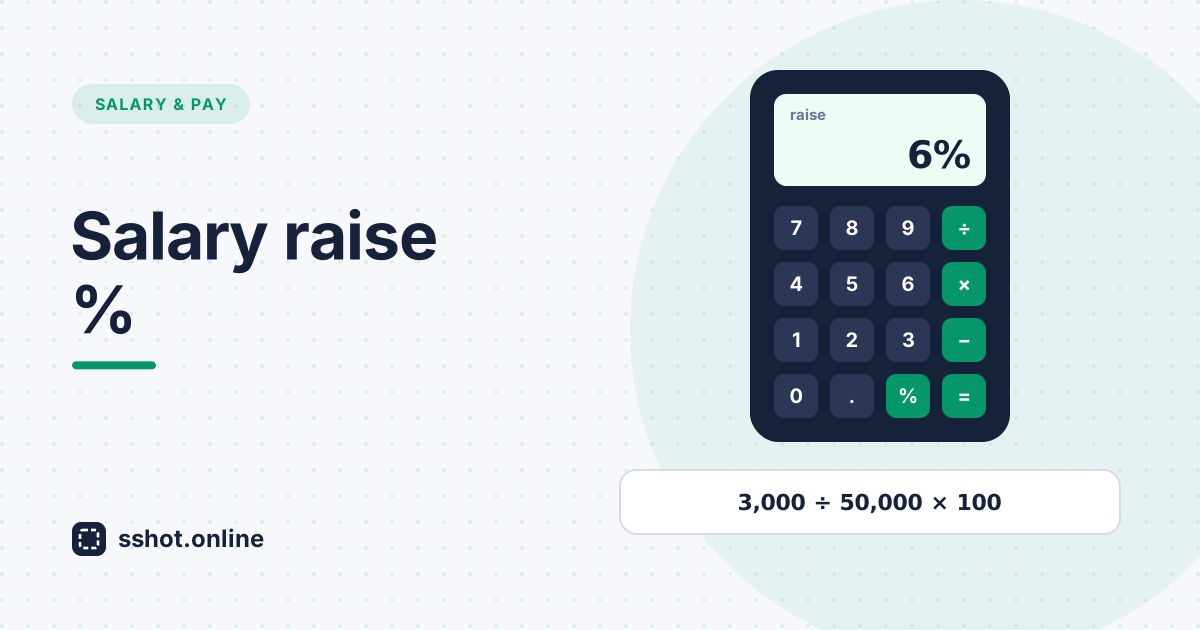
Raise percentage = (new salary − old salary) ÷ old salary × 100. From $50,000 to $53,000: $3,000 ÷ $50,000 × 100 = 6%.
New salary = old salary × (1 + raise ÷ 100). $48,000 with a 4% raise: $48,000 × 1.04 = $49,920.
Salary increase calculator
How to calculate your raise as a percentage
A percentage raise compares the extra money with what you earned before:
raise % = (new salary − old salary) ÷ old salary × 100- Find the difference. $53,000 − $50,000 = $3,000.
- Divide by the old salary. $3,000 ÷ $50,000 = 0.06.
- Multiply by 100. 0.06 × 100 = 6%.
More examples
| Old pay | New pay | Difference | Raise |
|---|---|---|---|
| $50,000 a year | $53,000 | $3,000 | 6% |
| $42,000 a year | $45,000 | $3,000 | 7.14% |
| $3,200 a month | $3,400 | $200 | 6.25% |
| $18.00 an hour | $19.50 | $1.50 | 8.33% |
| $60,000 a year | $57,000 | −$3,000 | −5% (a pay cut) |
The formula works for any pay period, yearly, monthly or hourly, as long as the old and new amounts use the same one. Notice the first two rows: the same $3,000 is a bigger raise on a smaller salary.
How to calculate your new salary from a percentage
If you know the percentage, turn it into a multiplier: a 4% raise means multiplying by 1.04.
new salary = old salary × (1 + raise ÷ 100)- $48,000 with a 4% raise: $48,000 × 1.04 = $49,920 (an extra $1,920 a year, or $160 a month).
- $65,000 with a 3.5% raise: $65,000 × 1.035 = $67,275.
- $22.50 an hour with a 5% raise: $22.50 × 1.05 = $23.63 (rounded).
What common raises add to a $50,000 salary
| Raise | New salary | Extra per year | Extra per month |
|---|---|---|---|
| 2% | $51,000 | $1,000 | $83.33 |
| 3% | $51,500 | $1,500 | $125.00 |
| 4% | $52,000 | $2,000 | $166.67 |
| 5% | $52,500 | $2,500 | $208.33 |
| 10% | $55,000 | $5,000 | $416.67 |
Is your raise beating inflation?
A raise only makes you better off if your pay grows faster than prices. The difference is your real raise. The quick estimate is to subtract inflation from your raise: a 5% raise with 3% inflation is roughly a 2% real raise.
The exact formula is:
real raise % = ((1 + raise ÷ 100) ÷ (1 + inflation ÷ 100) − 1) × 100With a 5% raise and 3% inflation: 1.05 ÷ 1.03 = 1.0194, so the real raise is 1.94%. If your raise is smaller than inflation, the result is negative: you can buy less than last year even though the number on your payslip went up. Add your country's inflation rate in the calculator above to see this for your own raise.
Three mistakes to avoid
1. Dividing by the new salary
Always divide by the old salary. $3,000 ÷ $53,000 gives 5.66%, which undersells a 6% raise.
2. Adding raises together
Two 3% raises in a row aren't 6%. The second raise is on the already-raised salary: 1.03 × 1.03 = 1.0609, so it's 6.09%. Over many years this compounding adds up.
3. Expecting a cut and a raise of the same size to cancel out
After a 10% pay cut, a 10% raise doesn't bring you back. $50,000 cut by 10% is $45,000, and 10% of $45,000 is only $4,500, which takes you to $49,500. To get back to $50,000 you'd need an 11.11% raise (1 ÷ 0.9 − 1).
Asking for a raise? Use the numbers
When you negotiate, show both the percentage and the money. "A 6% increase" sounds abstract. "$3,000 a year, or $250 a month" is concrete. If inflation has been high, show that your real pay fell last year, and ask for at least enough to make up for it.
Related calculations
- Compare an hourly offer with a salary: salary to hourly rate.
- Paid by the hour? See how overtime pay is calculated.
- Moving to part-time? Work out the pro-rata salary.
Frequently asked questions
How do I calculate a salary increase percentage?
Subtract the old salary from the new salary, divide the difference by the old salary and multiply by 100. A raise from $50,000 to $53,000 is $3,000 ÷ $50,000 × 100 = 6%.
How do I calculate my new salary after a percentage raise?
Multiply your current salary by 1 plus the raise as a decimal. A 4% raise on $48,000 is $48,000 × 1.04 = $49,920.
How much is a 3% raise on $50,000?
A 3% raise on $50,000 is $1,500 a year, taking the salary to $51,500. That's $125 more per month before tax.
How do I know if my raise beats inflation?
Compare the raise with the inflation rate for the same period. The real raise is (1 + raise) ÷ (1 + inflation) − 1. A 5% raise with 3% inflation is a real raise of about 1.94%. If the result is negative, your buying power fell.
Are two 3% raises the same as one 6% raise?
No. The second raise applies to the already-raised salary, so two 3% raises add up to 6.09%, slightly more than 6%.
Related articles
Salary to Hourly: How to Convert Your Salary to an Hourly Rate (with Examples)
Turn a yearly or monthly salary into an hourly rate with one simple formula. Free calculator, quick reference table and worked examples.
Read More →
How to Calculate Overtime Pay: Time and a Half and Double Time Examples
The time-and-a-half formula, double time, daily overtime and overtime on a salary, with a free calculator to check your payslip.
Read More →
How to Calculate Pro-Rata Salary for Part-Time Work or a Partial Month
Pro-rata pay for part-time hours, FTE and leave, plus pay for a month when you start or leave mid-month. Free calculator and examples.
Read More →